Saturday, 6 May 2017

India Becomes No 1 Two-Wheeler Market, Overtakes China


India has overtaken China to become the number one two-wheeler market in the world, overtaking China in overall sales for 2016, according to the Society of Indian Automobile Manufacturers (SIAM). India sold 17.7 million two-wheelers in 2016, against China's sales of 16.8 million two-wheelers. Scooter sales alone accounted for over 5 million of those figures, while commuter motorcycles in the 100-110 cc segment accounted for nearly 6.5 million unit sales.

In terms of pure volumes, China's two-wheeler market is huge, but China's domestic motorcycle market has seen a downturn in recent years due to a ban of motorcycles in many Chinese urban centres.  

  2010 2011 2012 2013 2014 2015
Motorcycle Sales in China (In Million) 27.51 27.22 26.37 25.75 26.95 24.56

In 2010, China's domestic motorcycle sales reached over 27 million and then decreased gradually over the next four consecutive years. Comparatively, two-wheeler sales in India have been on an uptrend over the past few years. In 2011-12, India sold over 13 million two-wheelers, which increased to nearly 16 million unit sales by 2014-15. As it stands currently, India's two-wheeler sales are over 17 million at the end of the financial year 2016-17.

  2011-12 2012-13 2013-14 2014-15 2015-16 2016-17
Two-Wheeler Sales in India (In Million) 13.40 13.80 14.80 15.97 16.45 17.67 

There are several reasons for the downtrend in the Chinese two-wheeler market. The Chinese domestic market is highly regulated and import barriers are high, reducing motorcycle imports. Moreover, there is no developed motorcycle culture like in the West, so higher capacity motorcycles don't see any significant sales growth.

Additionally, about 200 municipalities and cities have banned motorcycles completely from their downtown areas. Heavier bikes with larger engine sizes are officially forbidden from entering the urban area. More importantly, declining motorcycle sales in China are also attributed to the availability of inexpensive Chinese cars. These cars, produced by domestic car makers pose a threat to the two-wheeler market. In India on the other hand, the two-wheeler market is rapidly increasing with a corresponding rise in spending power, and without any restrictions such as China's. The bulk of India's two-wheeler sales comes from commuter motorcycles and automatic scooters.

2017 Honda City Facelift Receives Over 25,000 Bookings

The 2017 Honda City facelift has received over 25,000 orders since it was launched in India in February 2017. The fourth-generation of the Honda City car, among the company's most popular models in India, had in fact bagged more than 14,000 bookings within one month of its launch here. Yoichiro Ueno, President and CEO, Honda Cars India had said in March that over 40 per cent of the bookings for the Honda City were for the top-of-the-line ZX variant - an occurrence even the carmaker hadn't expected considering the fact that the variant in question costs ₹ 13.52 lakh (ex-showroom, Delhi).


Yoichiro Ueno said: "HCIL sales continue to grow positively and we registered our higher ever April numbers backed by strong demand for New City 2017 and Honda WR-V. The new fiscal year has begun on a positive note and we hope to continue the growth momentum."
Honda City Facelift 2017 was launched in India on 14 February with a myriad of cosmetic upgrades and new features though it continues to be offered with the same engine options as its predecessor - the 1.5-litre petrol and 1.5-litre diesel. Offered across a total of 11 variants, the model comes loaded with an impressive array of provisions such as LED daytime running lights, LED headlamps, a 7-inch touchscreen audio-visual navigation system with an Android based interface, dual airbags, ABS with EBD, and ISOFIX mounts for child seats. And if you were wondering, Honda City's price ranges between ₹ 8.5 lakh to ₹ 13.56 lakh (ex-showroom, Delhi).

Skoda Launches Its First Digital Showroom

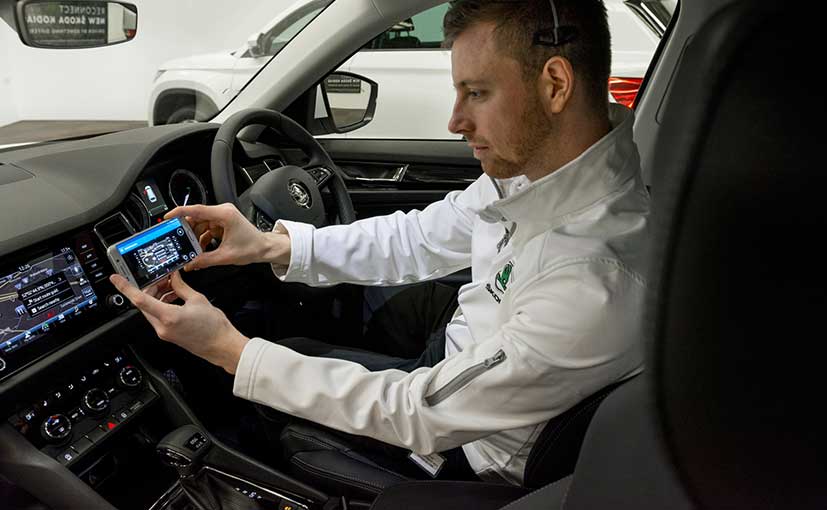
Skoda has launched its first online showroom, Skoda Live Tour, in the UK. The facility allows customers to access the online showroom on their computer, tablet or smartphone and receive the showroom experience at a time and place of their convenience. The Czech carmaker's online showroom connects the customer to a Skoda Product Host via an internet video link, who takes patrons into the Live Tour showroom and acquaints them with the company's models. Prospective customers in the UK can now also receive an online consultation with a Skoda Product Host. To access Skoda Live Tour, customers simply need to click on simple button on the product homepage that registers their request for an immediate call back or schedules an appointment at their convenience.

Jonathan Harris, Skoda New Retail Concepts Manager, said, "Customers are seeking convenience and excellent service when looking to make a car purchase, and with more and more people doing their research online ahead of going to the showroom, the Skoda Live Tour brings the retail experience to a digital world that is easily accessible. Our Skoda Product Hosts in the Live Tour essentially become our customer's eyes and ears and use a series of static and handheld cameras to give the retailer experience all through an online platform. This is an important step for the brand and the future of automotive retail and how we interact with customers. Once we have opened up dialogue with the customers in the online environment, we then encourage them to visit a Skoda retailer and test drive our models for real."


skoda digital showroom live tour
Skoda Live Tour connects the customer to a Product Host via an internet video link

Skoda' s Live Tour uses Whisbi's cloud-based conversational technology to help the real retailer experience transition online. Additionally, Skoda's Product Hosts will uses a combination of smartphone camera and static cameras to showcase the details of the cars. Other than that, the Product Host can assist the customer in configuring their desired vehicles online, search for a local retailer, and register a request for a test drive in person.

jaguar land rover digital store
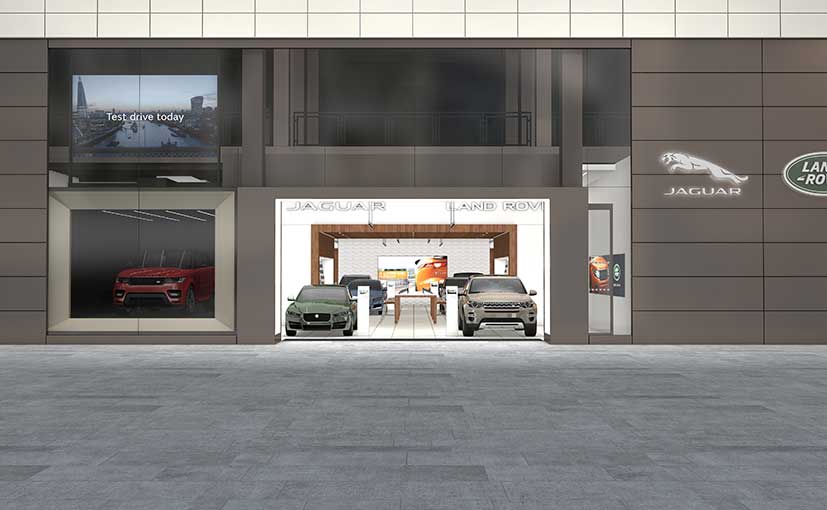
Jaguar Land Rover Digital Store in Westfield Stratford, London

It must be noted Skoda isn't the first carmaker to establish a digital pathway to buying a car. Several companies including Audi, Jaguar Land Rover, and Hyundai have online showrooms and digital dealerships across the world. Audi revealed its virtual showroom at the 2016 Consumer Electronics Show in Las Vegas, whereas JLR introduced 'Virtual Experience' in 2012 that allowed customers to engage and interact with an almost life-size high resolution rendering of any of the company's vehicles. The British carmaker also launched a digital retail website and accompanying store in the Westfield Stratford shopping centre in Stratford, London last year.

SOURCE

Monday, 1 May 2017

TVS To Launch New Scooter, Motorcycle


TVS Motor Company will launch two new products - an all-new scooter and a motorcycle - this fiscal, a senior TVS official has said. Additionally, TVS also plans to upgrade existing models to expand its two-wheeler portfolio. The Chennai-based two-wheeler manufacturer has also earmarked capital expenditure worth Rs 500 crore for the current fiscal, which will be invested in the company's three manufacturing plants to ramp up production of existing, as well as new models. TVS Motor Company has manufacturing plants at Mysore in Karnataka, Hosur in Tamil Nadu and Nalagarh in Himachal Pradesh.

"Besides regular upgrades and refreshes of existing products, we plan to launch a new scooter and a bike this fiscal," TVS Motor Company CFO and Executive Vice President, Finance SG Murali said. He however, did not share details about the upcoming products.

tvs apache rtr 310 spied
Production-ready TVS Apache RTR 310

The new motorcycle to be launched by TVS is expected to be the new TVS Apache RTR 310, a full-faired, entry-level sportbike built on the same engine as the BMW G 310 R, a bike jointly developed by TVS Motor Company and BMW Motorrad. The BMW G 310 R is made in India at the TVS manufacturing plant and is already on sale in Europe and the US.

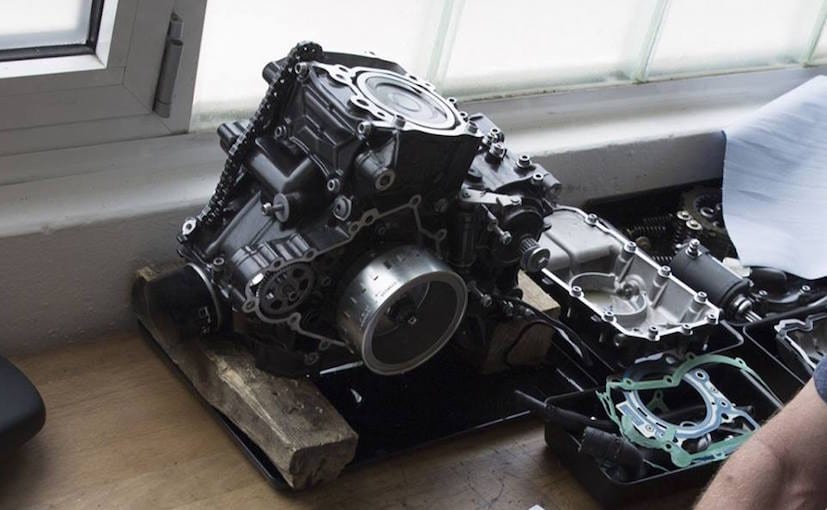
In India, the first bike to be launched under this partnership is expected to be the Apache RTR 310, expected to be launched in July 2017. The BMW G 310 R launch will be afterwards, sometime in late 2017 or maybe even in early 2018. The difference in these two bikes is that, while the BMW G 310 R follows a naked street styling, the Apache RTR 310 will be a full-faired sportbike, the first such offering from TVS. The engine is the same as the BMW's - a single-cylinder, liquid-cooled, four-stroke 313 cc engine which makes 34 bhp and 28 Nm on the G 310 R. The engine has a unique, reverse cylinder layout, with the intake pointing to the front and the exhaust towards the rear of the engine when mounted on the chassis.

bmw g 310 r production engine
BMW G 310 R production engine with reverse cylinder layout

The Apache RTR 310 is expected to be priced around Rs 1.6-1.7 lakh (ex-showroom Delhi) and will be one of the most competitively priced full-faired bikes in the segment. TVS has a strategic partnership with BMW Motorrad to develop and manufacture sub-500 cc bikes both for domestic and global markets. The two companies had announced the collaboration in 2013.
"We have started to export the BMW G 310 R and our version of the motorcycle will be launched this fiscal," Murali said.

tvs jupiter bs iv
2017 TVS Jupiter

The new scooter in question is expected to be an all-new 125 cc scooter. TVS sells scooters under the Jupiter, Wego and Scooty brands, but all these scooters are in the sub-110 cc segment. The Jupiter is the company's largest-selling scooter model, and is currently the second largest selling scooter in India as well. In 2016-17, TVS sold nearly 7.5 lakh scooters, overtaking Hero MotoCorp to become the second highest-selling scooter manufacturer after Honda Motorcycle & Scooter India. The 125 cc scooter is expected to be launched under the Jupiter brand name.

Isuzu MU-X SUV Launch Date Announced


After relative success with the likes of the Isuzu D-Max V-Cross, Isuzu is all set to launch yet another SUV in the Indian car market, the MU-X, on the 11th of May 2017. The new Isuzu MU-X will replace the company's current flagship model in India - the MU-7. Last year, back in early September 2016, Isuzu had imported a new MU-X SUV to India for homologation and testing. The Isuzu MU-X will take on the likes of the Toyota Fortuner, Ford Endeavour, Chevrolet Trailblazer and the upcoming Skoda Kodiaq too with its seven-seat layout.
The Isuzu MU-7, which the MU-X will replace, never really found success in the Indian market mainly because mainly because the SUV looked outdated and not as feature-rich as its aforementioned rivals. Moreover, Isuzu was a still a new brand back then and customers had much better and reliable options to choose from. As for the new Isuzu MU-X, the SUV is a lot more modern both visually and in terms of features and equipment. It certainly looks more contemporary and stylish compared to the outgoing MU-7. The SUV is based on the new-generation D-Max pick-up truck, which was developed in collaboration with General Motors and was first introduced in 2013 internationally. It has been very successful in other south-east Asian markets like Thailand and Indonesia and is also sold in other right-hand-drive (RHD) markets like Australia, Malaysia and Philippines.

In terms of exterior design, the Isuzu MU-X gets a large twin-slat chrome grille up front, flanked by sharp headlamps with projector lights and a muscular bonnet. The beefy front bumper houses the wide central air dam, round chrome-tipped fog lamps and an aggressive skid plate. The SUV also features flared wheel arches, 17-inch alloy wheels and roof rails all adding to its brawny profile. It will come with a 7-seater cabin layout equipped with premium upholstery and comfort features like automatic climate control, rear AC vents and cruise control. The MU-X will also get a height adjustable driver seat, ABS with EBD, terrain management system and few others.
Under the hood, the vehicle is likely to get the same 3.0-litre diesel engine that does duty on the existing MU-7, which churns out 161 bhp and develops a peak torque of 360 Nm. Transmission options will also likely remain unchanged, a 5-speed manual or a 5-speed conventional automatic. The MU-X will also most probably get a four wheel drive variant in the line-up, a feature that the MU-7 never received in India in the past.

2017 Honda Activa i, Honda Aviator Launched


Honda Motorcycle and Scooter India (HMSI) has introduced the 2017 Honda Activa i and Honda Aviator scooters with updated Bharat Stage IV (BS-IV) compliant engines. With the introduction of these two updated models, Honda's entire scooter line-up is now BS-IV compliant. Both the Activa i and the Aviator now also come with the automatic headlamp on (AHO) function, in line with the new safety norms. The Honda Activa i is priced at ₹ 47,913 (ex-showroom Delhi), while the Aviator is priced in the range of ₹ 52,077 to ₹ 56,454 (ex-showroom, Delhi).
 While visually the Honda Aviator sees no new change, the Activa i comes with an updated colour pallette in five new options. All colour options are in dual tone and come with new graphics on the side panels. The new colour options include - orchid purple metallic, lush magenta metallic, neo orange metallic, black, and imperial red metallic. The Activa i also gets body-coloured mirrors, unlike the Aviator that comes with black mirrors.
Both the Honda Activa i and the Honda Aviator are powered by the same 109.19 cc air-cooled, four-stroke engine that makes 8 bhp of peak power and develops a maximum torque of 8.94 Nm. The BS-IV compliant motor is paired to a V-Matic transmission unit as was the outgoing model. Due to its beefier dimensions and the inclusion of more metal components, the Aviator is 2 kg heavier than the Activa i, at 105 kg. This additional weight also restricts the Aviator's top-speed to 82 kmph, while the Activa i's top-speed is rated at 83 kmph.
In terms of suspension and brakes, the Activa i comes with the spring loaded hydraulic type suspension at both front and rear, while steel wheels and drum brakes come as standard on both ends. The Honda Aviator, on the other hand, gets telescopic suspension up front and spring loaded hydraulic suspension at the rear. The Aviator also offers three options for wheels and brakes combination - front drum brakes with steel wheels, front drum brakes with alloy wheels and the top-end model that comes with alloy wheels and front disc brake. The rear wheels of both the scooters come with drum brake along with Honda's combined braking system (CBS) as standard.                            

Honda CBR250R, CBR150R Sales Temporarily Stopped

 simplezoom-img
 
Honda Motorcycle and Scooter India (HMSI) has stopped sales of the Honda CBR150R and the Honda CBR250R motorcycles. The two models have already been taken off the company's website and are no longer available on sale, although they haven't been discontinued. HMSI officials said that the two motorcycles are yet to be upgraded to meet the Bharat Stage IV (BS IV) emission norms which came into effect from April 1, 2017 and so, for the time being, these have been taken off the website. HMSI says that it will launch the BS IV compliant models of the CBR150R and the CBR250R soon.
 
honda cbr 150r (Honda CBR150R)

The Honda CBR150R and CBR250R are the only two full-faired motorcycles in the 150 cc and 250 cc motorcycle segments from Honda. While the CBR150R is priced below the Rs 1.5 lakh mark, the CBR250R is priced below Rs 2 lakh (ex-showroom Delhi). Although not seen as volumes gainers in HMSI's motorcycle portfolio, both these models attract significant fan following and sales. In FY2017, the Honda CBR150R sold over 5,466 units, losing 3,189 units over the same period a year ago. The CBR250R, which has been in production since 2011, has made quite a mark as a do-it-all bike among enthusiasts, doubling up as a daily commuter and occasional tourer. Honda has not updated the CBR250R since 2013. The bike sold an average of 214 units every month for FY2017, over the average monthly sales of 290 bikes in FY2016.

Models Sales (April 2015- March 2016) Sales (April 2016-March2017) Percentage Change
Honda CBR150R 8,655 units 5,466 units -36.85%
Honda CBR250R 3,485 units 2,570 units -26.26%

The Honda CBR150R and CBR250R are the only two full-faired motorcycles in the 150 cc and 250 cc motorcycle segments from Honda. While the CBR150R is priced below the Rs 1.5 lakh mark, the CBR250R is priced below Rs 2 lakh (ex-showroom Delhi). Although not seen as volumes gainers in HMSI's motorcycle portfolio, both these models attract significant fan following and sales. In FY2017, the Honda CBR150R sold over 5,466 units, losing 3,189 units over the same period a year ago. The CBR250R, which has been in production since 2011, has made quite a mark as a do-it-all bike among enthusiasts, doubling up as a daily commuter and occasional tourer. Although Honda has not updated the CBR250R since 2013, the bike still sells an average of 290 units every month for FY2016, over average sales of 214 bikes every month in FY2017.

HMSI offered massive discounts on these two bikes at the end of March 2017 to clear out existing stocks of motorcycle which do not meet the updated BS IV regulations. For instance, the top-end Repsol variant of the Honda CBR250R, which costs Rs 1.92 lakh (ex-showroom Delhi), was offered with discounts of Rs 25,000. The Honda CBR250R was launched in India in 2011, while the CBR150R was launched in India in 2012. With these two models off the market, HMSI currently offers the Honda CB Hornet 160R as its premium commuter offering in the sub-Rs 2 lakh segment.

Maruti Suzuki Alto Sales Cross the 1 Lakh Mark In 5 Months

The Maruti Suzuki Alto has always been one of the bestsellers from the stables of the company. Maruti Suzuki recently announced that its Al...